

An old timer given a new lease on life
Posted 22 May 2026
Such are the habits of gardeners, plant people and botanists that the one often seems to be chasing the other with new information, new discoveries and new plants.
Catching up and keeping up are features of the gardening game. Advances in technology and science are too often blamed for the endless name changes that appear – well, endlessly. However, home gardeners and amateur hybridists must also bear some responsibility for the same so-called problems of nomenclature.
Take, for example, the recent history of a well-known group of so-called veranda plants, treasured for at least 150 years.
These plants, bulbs actually, have been kept in pots to protect them against damage and loss by cold weather and browsing animals. What were formerly known to our grandparents and maiden aunts twice removed as Valotta Lilies and Scarborough Lilies have recently been reviewed by botanists and shifted into the genus Cyrtanthus, whose name means fire lilies or Ifafa lilies. The name originates from Greek kyrtos (curved) and anthos (flower). Is that clear? If the confusion persists, remember science will make things clear, given time.
Typically, the flowers of many species are long, tubular and semi-pendant. They are carried at the apex of curving stems, which rise above grassy or strappy foliage. Cyrtanthus macowanii (above) is the best known of this type. It has orange-tinted red flowers in small clusters. There is a creamy yellow variety, Cyrtanthus mackenii. Both come from the east coast of South Africa, where Summers are rainy.
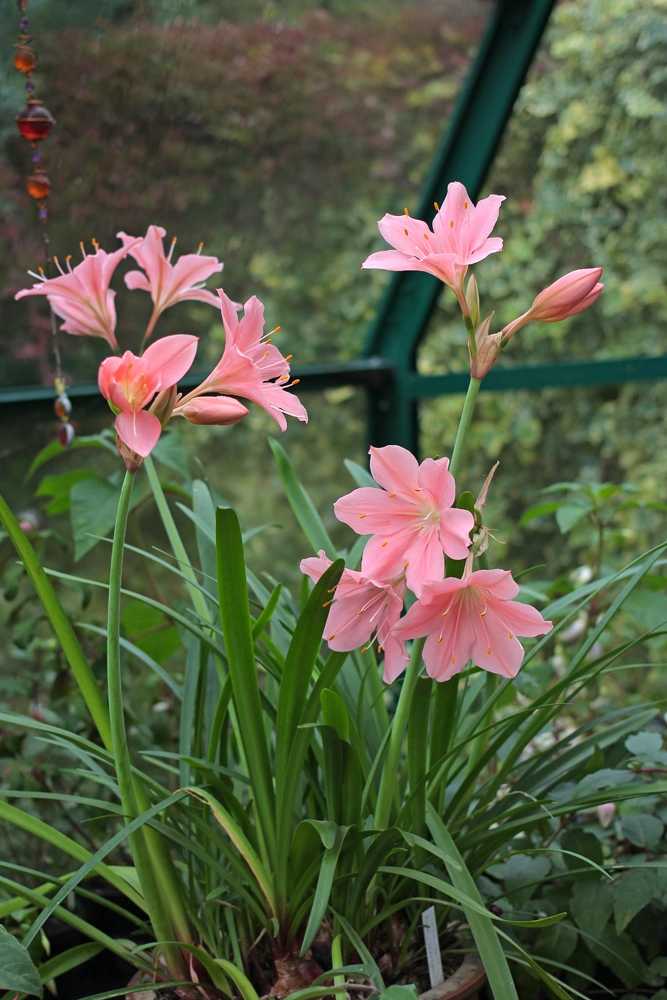
Not all Cyrtanthus have long, tubular flowers; some are campanulate (bell-shaped) and yet others are wide open, almost flat, as in Cyrtanthus elatus. This diversity may explain why confusion arose when the plants were first discovered and named.
Cultivation is straightforward. The essential requirements are a free-draining potting mix, regular but light feeding, and attention to watering to avoid over-watering when the bulbs are dormant. Bright light is necessary. Over time, the bulbs will increase prolifically and are best left to crowd the pot rim to rim.